

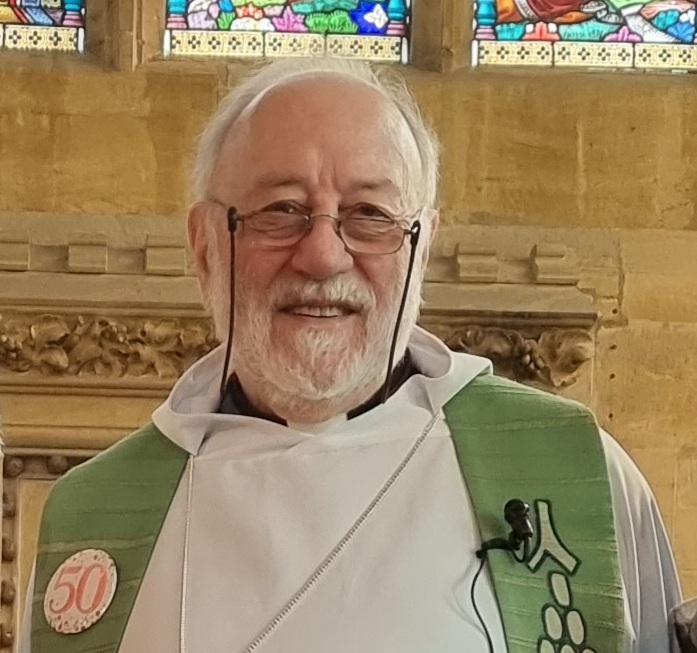
The Reverend Richard Terrell is a retired Priest who remains in active Ministry.
Recently he celebrated the Fiftieth Anniversary of his Ordination to the Priesthood.
He is the Co-ordinator of the Norton Festival which brings together the local community,
with support for the Parish Church and other local concerns.
Sermon of the month
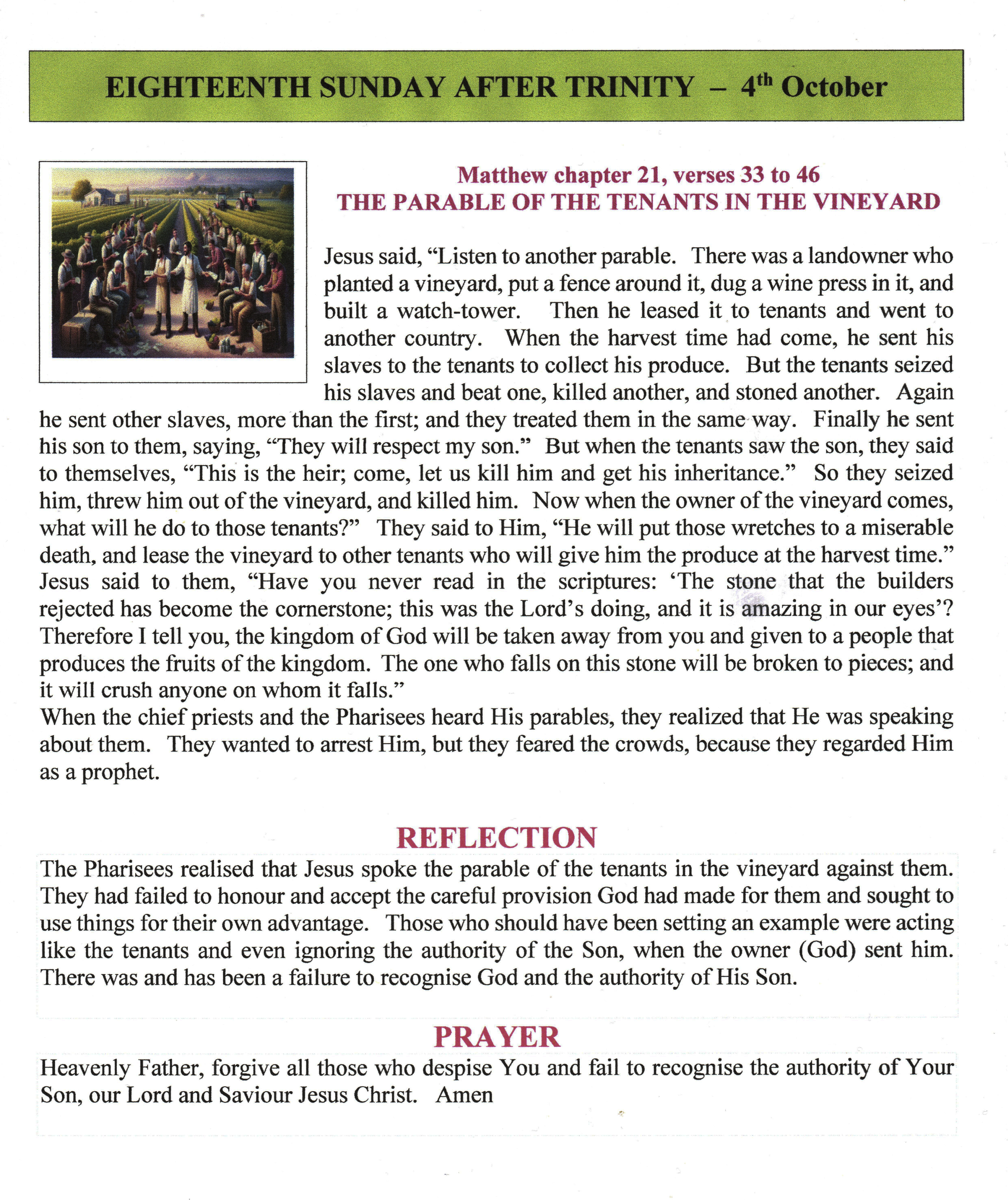
THE PARABLE OF THE WICKED TENANTS
Matthew 21:31-46
As a child, I loved it when my parents read me a story. A favourite with me was the Thomas the Tank Engine stories, moral stories told originally to his children by The Reverend William Awdry
Jesus told stories – parables – to convey His teaching. Scripture records some memorable tales such as “The Good Samaritan,” “The Prodigal Son” and so on. I wonder whether you have a favourite parable.
This morning we were hearing The Parable of the Tenants in the Vineyard who did not care for the land that had been entrusted to them and who ended up killing the landowner’s servants and his Son when they attempted to collect dues from the tenants.
What did YOU make of it and did you see what Jesus was saying?
Parables often make only one point and should not be allegorized. But in this parable the landowner was quite clearly God and Jesus was referring to Israel as the vineyard that had been leased to tenants.
The tenants – the people of Israel – regarded themselves as ‘God’s Chosen People’ – they had been given a special position and responsibility in life. But their leaders – like the tenants in the vineyard – had neglected their duty of care.
There had been times of reckoning when God sent His servants – the prophets – but they were often treated badly. Amos was struck on the head and died. Isaiah was martyred by being sawn in half and Zechariah was stoned to death in the temple courtyard. So in the parable Jesus was recalling how historically the prophets had been rejected and killed. He also predicted, in the parable, that He Himself – the landowner’s son – would be killed.
Parables addressed the situation of the time but can also be applied to the present day. So we must ask, ‘who are the tenants in God’s vineyard today?’ The temptation might be to identify them as the leaders of the Church – forgetting that, as Christians, we are all workers in God’s vineyard. So it is OUR responsibility to tend for His vineyard and to pass on our Christian Faith to those around us.
The parable warns us to take our responsibility of care for God’s vineyard seriously. It warns us that there are those today who attempt to kill and stifle the Word of God. It is bewildering to think that the leadership of His day plotted to kill Jesus but today it can be equally disturbing to realize who might now be attempting to kill the Word of God.
In the parable Jesus quoted from Psalm 118 – verse 22 – saying: ‘The stone that the builders rejected has become the cornerstone; this is the Lord’s doing, and it is amazing in our eyes.’ Jesus was to be rejected but He and His teaching would become the cornerstone of our Faith.
When His teaching is taken away from life everything crumbles. But thanks be to God for those tenants who were and are faithful and caring in passing on our Christian teaching and thus making Jesus and His teaching the cornerstone of our lives.
Today we are challenged to ensure we are one of those faithful and caring tenants who leave our Church this morning looking after the vineyard that has been entrusted to us and bringing others into God’s kingdom.
West Chinnock 2026
MARTIN’S MESSAGE

Martin the Monkey sometimes accompanies The Reverend Richard and helps to re-enforce the Gospel message. He usually attends on special occasions in the Church Year and shares his thoughts with you.
REVEALED
We cannot fully appreciate an object or an issue until we have seen all aspects of it. Things might appear differently and arguments opened up into a very different debate. If we are not careful we might only see part of the ‘story’ instead of appreciating ‘the whole.’
One of the greatest things is to know God but our definition might only be partial and very incomplete. We might refer to him as Creator – the One whom we credit for our very being and everything we know and experience. Then we might refer to him as Redeemer – the one who came among us (Jesus) as our Saviour. We might also refer to him as the one who guides, influences and comforts us (The Holy Spirit).
In placing our image of God into compartments (Father, Son and Holy Spirit) we are tempted not to see him as one person. So we must recognise and identify the various ways in which our God is revealed and acclaim him as our One God, Father, Son and Holy Spirit.


